Blog

Image by Freepik

The Global breath: Understanding the impact of smoking and air-pollution on COPD

Chronic Obstructive Pulmonary Disease (COPD) is no longer a “hidden” disease; it is now one of the top three causes of death globally [1]. While many associate the characteristic cough and shortness of breath solely with cigarette smoking, the reality of this condition varies dramatically depending on where you live in the world [1][2].

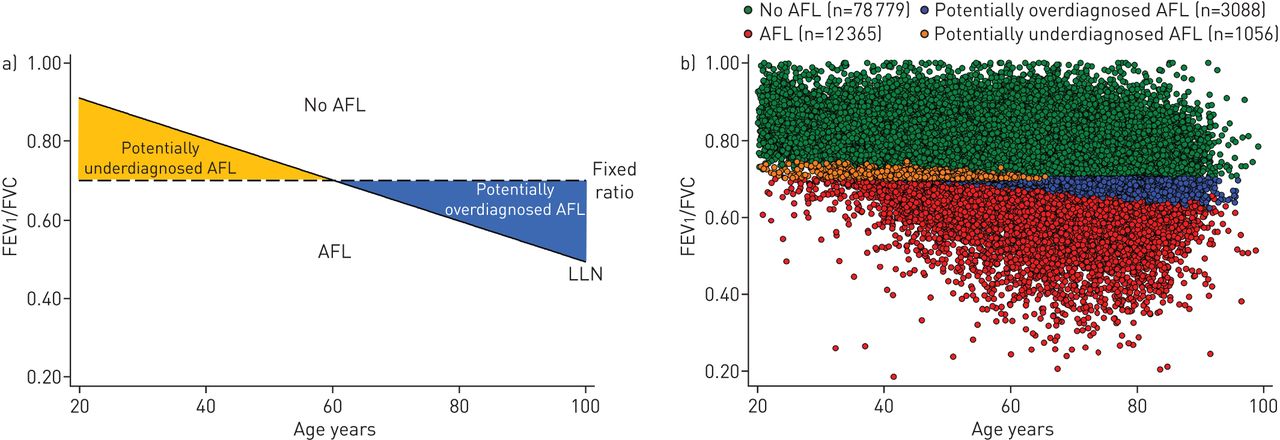
Figure 1: Definition of airflow limitation (AFL) and differences between the lower limit of normal and the fixed ratio criteria. (a) A theoretical depiction based on two different criteria for AFL, the fixed ratio and the lower limit of normal (LLN). (b) Assignment of individuals from the Copenhagen General Population Study to different criteria for AFL. No AFL was defined as forced expiratory volume in 1 s (FEV1)/forced vital capacity (FVC) ≥0.70 and FEV1/FVC ≥LLN. Potentially underdiagnosed AFL was defined as FEV1/FVC ≥0.70 and FEV1/FVC <LLN. Potentially overdiagnosed AFL was defined as FEV1/FVC <0.70 and FEV1/FVC ≥LLN. AFL was defined as FEV1/FVC <0.70 and FEV1/FVC <LLN [1].

The smoking connection

In high-income countries (HICs) like the United States and the United Kingdom, tobacco smoking remains the dominant cause of COPD, linked to 80% to 95% of all cases [2][3]. For those who smoke, the risk is severe: smokers are estimated to be 12 to 13 times more likely to die from COPD than those who have never picked up a cigarette [4] 

The damage caused by tobacco smoke is progressive and, in many cases, permanent, leading to persistent inflammation and irreversible airflow limitation [5][6].

A shifting global picture

Despite the strong link to smoking in HICs, the global burden of the disease is shifting. Nearly 90% of COPD deaths now occur in low- and middle-income countries (LMICs) [1]. Interestingly, in these regions, tobacco smoking accounts for only about 30% to 40% of cases [2].

This means that for a vast majority of the world’s population, other environmental factors are the primary drivers of lung disease.

The HO-1 Pathway: A Cellular Stress Response

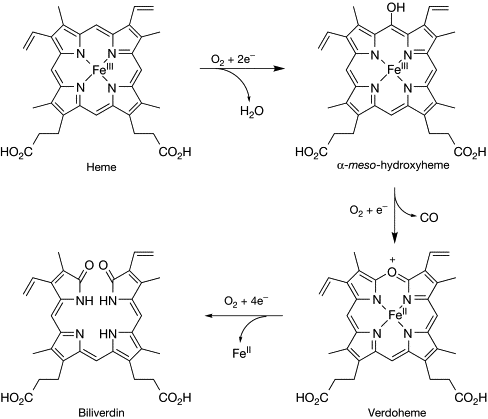
Oxidative stress is central to COPD pathogenesis. Exposure to tobacco smoke, biomass fuel, and environmental pollutants induces inflammatory cascades within the airway epithelium. A key adaptive response to this assault is the upregulation of Heme Oxygenase-1 (HO-1), a cytoprotective enzyme activated during oxidative and inflammatory stress [4]. HO-1 catalyzes the degradation of heme. Biochemically, the reaction proceeds as follows: 

Figure 2: The catabolism of heme by heme oxygenase (https://www.sciencedirect.com/topics/chemistry/biliverdin)

Beyond cigarette: Non-smoking risk factors

If not smoking, what is causing the high prevalence of COPD in LMICs? The sources point to several critical “non-smoking” risk factors:

  • Household Air Pollution: Nearly 3 billion people worldwide still rely on biomass fuels (wood, animal dung, and crop residues) or coal for cooking and heating [2]. In poorly ventilated homes, this exposure is a leading cause of COPD, particularly affecting women [1][2].
  • Ambient Air Pollution: In some regions, outdoor particulate matter has surpassed smoking as the leading cause of COPD-related disability [2].

Early Life Factors: Factors like maternal smoking in utero, childhood respiratory infections, and even prior tuberculosis can hinder lung development and increase the risk of developing COPD later in life [1][2].

A path forward

While the causes of COPD are diverse, the message from health experts is clear: COPD is both preventable and treatable [1][6]. For some, prevention means smoking cessation; for others, it means improving air quality and reducing exposure to toxic fumes [1]. By understanding the unique drivers in different regions, global health initiatives can better target the root causes of this life-threatening condition.

Reference

[1] Carpagnano, G. E., Resta, O., Foschino-Barbaro, M. P., Gramiccioni, E., & Barnes, P.J. (2003). Increased inflammatory markers in the exhaled breath condensate of cigarette smokers. European Respiratory Journal, 21(4), 589-593. https://doi.org/10.1183/09031936.03.00022203 

[2] Slebos, D. J., Ryter, S. W., & Choi, A. M. K. (2003). Heme oxygenase-1 and carbon monoxide in pulmonary medicine. Respiratory Research, 4, 7. https://doi.org/10.1186/1465-9921-4-7 

[3] Jarvis, M. J., Russell, M. A. H., & Saloojee, Y. (1980). Expired air carbon monoxide:  A simple breath test of tobacco smoke intake. British Medical Journal (BMJ), 281(6238), 484–485. https://doi.org/10.1136/bmj.281.6238.484   

[4] National Institute for Health and Care Excellence (NICE). (2008). PH10 Stop smoking services, evidence review (CO validation at 4 weeks). (PDF). https://www.nice.org.uk/guidance/ng209/evidence/ph10-stop-smoking-services-february-2008-pdf-10892313614 

[5] Montuschi, P., Kharitonov, S. A., & Barnes, P. J. (2001). Exhaled carbon monoxide  and nitric oxide in COPD. Chest, 120(2), 496–501. https://doi.org/10.1378/chest.120.2.496   

[6] Gatty Instruments AB (2025). https://gattyinstruments.com/   

[7] SPIROLUFT: A Next Generation Breath Analyser Utilising Simultaneous Spirometry & Pulse Oximetry, Säfström, Felix, Master thesis, Uppsala University, Sweden https://uu.diva-portal.org/smash/get/diva2:1916914/FULLTEXT01.pdf 

[8] The Role of Heme Oxygenase-1 in Pulmonary Disease, Laura E Fredenburgh, Mark A Perrella, S. Alex Mitsialis, Division of Pulmonary and Critical Care Medicine, Department of Medicine, Brigham and Women’s Hospital; and Division of Newborn Medicine, Children’s Hospital, Boston, Massachusetts. https://www.researchgate.net/figure/Degradation-of-heme-by-HO-1-HO-1-catalyzes-heme-degradation-to-biliverdin-IX-CO-and_fig1_6812848

Read More

The Global Breath: Understanding the Impact of Smoking and Air Pollution on COPD

Chronic Obstructive Pulmonary Disease (COPD) is no longer a "hidden" disease; it is now one of the...

The Subclinical Gap: Why Mechanical Lung Function Is a Lagging Indicator in COPD

For more than half a century, spirometry has defined how we diagnose Chronic Obstructive Pulmonary...

Cardiovascular Risk After an Acute COPD Exacerbation (AECOPD), Why Early Detection Matters

An acute exacerbation of COPD (AECOPD) is typically framed as a lung event, worsening...