
Grant Collaborations

Collaborate to Accelerate COPD Innovation
GattyInstruments AB (GIAB) collaborates with partners to develop and deliver projects focused on COPD prevention, early identification, monitoring, and improved care pathways.
We work with healthcare providers, researchers, community organisations, and industry partners to develop evidence-based proposals and implement projects in real-world healthcare settings.
Are you preparing a COPD-related grant application or looking for a consortium partner? We welcome discussions on potential collaborations, project objectives, partner roles, and implementation plans.
How We Collaborate
GIAB collaborates with healthcare providers, researchers, and industry leaders to drive advancements in COPD care.
We welcome opportunities to join grants and consortia for meaningful, real-world solutions.
Consortium Building
We help define roles, align partner strengths, and structure a deliverable work plan for competitive calls.
Grant Strategy & Fit
We map project ideas to call requirements, eligibility rules, and expected outputs to reduce proposal risk.
Proposal Coordination
We coordinate inputs, timelines, compliance checks, and final assembly to strengthen clarity and consistency.
Project Delivery Focus
We ensure governance, reporting, and planning to move from concept to execution.
Evidence & Communication
We refine project narratives, impact logic, and dissemination plans for funders and stakeholders.
Partner Type We Seek
We seek partners across healthcare, research, and industry to create impactful solutions for COPD.
Together, we aim to drive meaningful progress through collaborative expertise and shared goals.
Healthcare and Clinical Partners
- Outpatient clinics and specialist units (real-world testing and feedback)
- Primary care and rehabilitation providers (implementation pathways)
- Care pathway owners and procurement stakeholders (adoption readiness)
Academic & Research Partners
- Clinical and translational research teams (study design, outcomes, evaluation)
- Implementation research groups (feasibility, workflow integration, uptake)
- Health data science teams (analysis, modelling, and evaluation support)
Community & Civil Society Partners
- Patient and caregiver organisations (needs validation, engagement, co-design)
- Community organisations (reach and adoption in real-life settings)
Industry & Technology Partners
- Sensor, wearable, or digital health solution providers (complementary capabilities
- Data platform and integration partners (data handling and analytics support)
- SMEs and innovators building COPD-related solutions (joint proposals)
Why Partner with Us
Partnering with us means leveraging expertise, resources, and a collaborative approach to drive impactful COPD solutions.
Together, we turn ideas into actionable, real-world outcomes.
Partner-Centric Collaboration
Clear, partner-friendly collaboration approach focused on roles, deliverables, and realistic execution.
Multi Country Expertise
Experience working in multi-country projects and consortia environments (as evidenced by our project portfolio).
Home Monitoring Focus
Commitment to outpatient and home monitoring settings where practical adoption matters.
Implementation Clarity
Focus on proposal clarity, compliance discipline, and credible implementation pathways.
Our Projects
Active Project
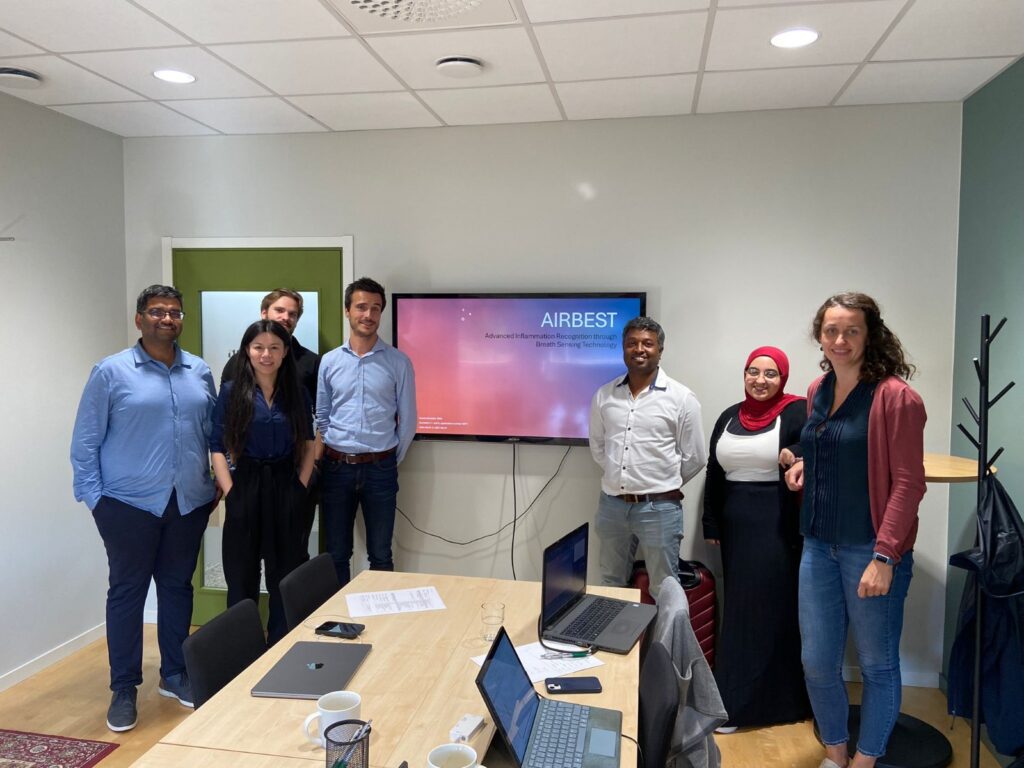
AIRBEST
Role: Coordinator
Consortium website: airbest-copd.com
Research project. The technologies studied are not CE-marked and are not part of the intended purpose of Spiroluft
Purpose
Advancing technologies in respiratory diagnostics to support early detection and management of respiratory conditions.
What We Do
- Participate in an international consortium focused on respiratory diagnostics innovation.
- Contribute to project activities aligned with developing next-generation exhaled breath measurement for COPD detection.
Partner Opportunities
- Partners with complementary respiratory diagnostics expertise or validation capacity for future projects.
- Organisations interested in joint applications targeting COPD early detection and monitoring.
Project Aim
The AIRBEST project aims to develop a next-generation exhaled breath-measuring instrument that accurately detects and informs users and healthcare providers about COPD.
Project Objective
To develop an advance diagnostic instrument for the detection of lung disease.
Partner Overview
- Budget: 1.5M Euro
- Duration: 3 Years
- Partners: 3
- Countries: France and Sweden
Partners




Past Project
Masimo
Role: Consultant

Research project. The technologies studied are not CE-marked and are not part of the intended purpose of Spiroluft
Purpose
Pre-study of next-generation exhaled breath sensors and systems.
What We do
Consulting project from June 2021 – December 2023.
Project Title
System and Method for Continuous Monitoring of Volatile Compounds in Breath
Let’s Advance COPD Research Together
Advancing solutions for Chronic Obstructive Pulmonary Disease (COPD) requires strong, multidisciplinary partnerships. We collaborate with healthcare providers, researchers, community organizations, and industry partners to develop innovative, evidence-based grant proposals that improve prevention, early detection, treatment, and patient outcomes.
What to include in your message
- Your organisation type (clinic, university, SME, community organisation, etc.)
- Country and eligibility constraints you must follow (if known)
- What you can contribute (clinical site, evaluation, data science, technology, community access)
- Which calls or programmes you are targeting (or your preferred timeline)
- Your proposed role and what you are looking for from the consortium
Interested in partnering on a COPD-related grant? Let’s stay in touch to explore collaboration opportunities.
Active Project
C-COPE - Test and Demonstration of Multimodal Data Approaches for Personalised Medicine (“MultiPMData2026”)
Purpose
Evaluating a multimodal digital monitoring and early-warning approach for COPD–CVD multimorbidity following AECOPD.
Role
To be confirmed.
What We Do
- Work on an integrated approach combining home lung-function monitoring with exhaled carbon monoxide, cardio-respiratory remote monitoring via a wearable wristband with environmental data access, wrist-based ECG for heart rate and rhythm assessment including atrial fibrillation detection, and a prediction platform integrating sensor data, patient-reported outcomes, environmental exposures, and clinical history.
- Support testing in real-world outpatient and home-monitoring settings across Sweden and Türkiye.
- Contribute to implementation-ready evidence for personalised early-warning systems in COPD–CVD care pathways.
Partner Opportunities
- Clinical and care partners interested in outpatient and home-monitoring evaluation settings.
- Research teams supporting implementation evaluation, feasibility, and patient engagement approaches.
- Technology/data partners supporting integration and analysis within project constraints.
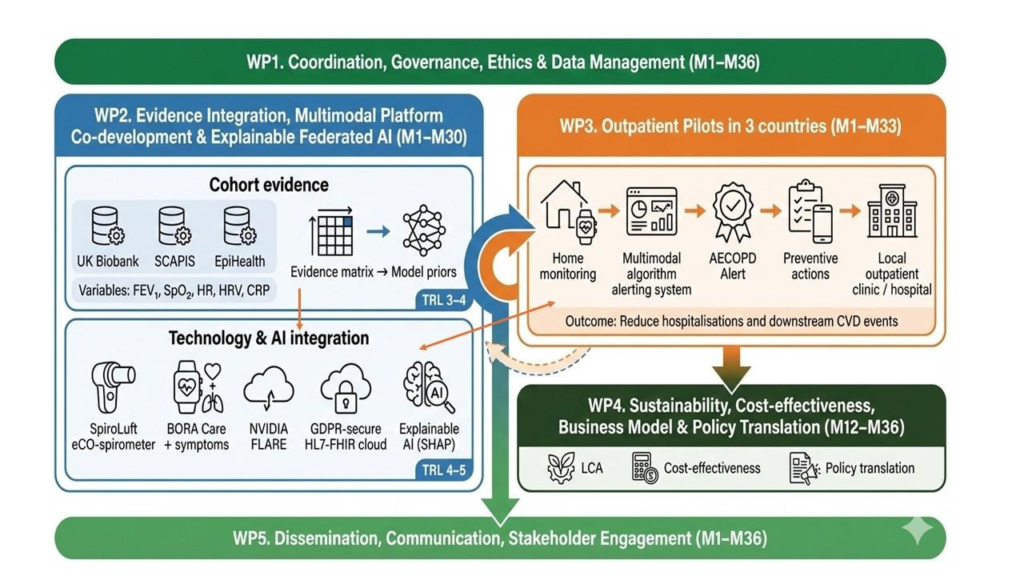
C-COPE addresses a critical gap in personalized multimorbidity care: the sharp, short-term rise in cardiovascular disease (CVD) events following acute exacerbations of chronic obstructive pulmonary disease (AECOPD). Evidence shows that for patients with COPD and established CVD, the first 1–7 days after an AECOPD episode constitute a peak window of preventable cardiovascular risk, with increased incidence of myocardial infarction, heart-failure decompensation, arrhythmias, stroke, hospitalization, and early mortality. Current care pathways remain largely reactive, identifying deterioration only after symptom escalation or emergency presentation.
C-COPE aims to close this gap through a personalized, multimodal digital monitoring and early-warning system for outpatient and home use that predicts and mitigates cardiovascular deterioration triggered by AECOPD. The project will evaluate an integrated solution combining home lung-function monitoring with exhaled carbon monoxide, CE-marked cardio-respiratory remote monitoring via a wearable wristband with environmental data access, wrist-based ECG for heart rate and rhythm assessment including atrial fibrillation detection, and an explainable prediction platform integrating sensor data, patient-reported outcomes, environmental exposures, and clinical history. Earlier detection of pre-symptomatic physiological changes enables timely clinical review during the highest-risk period, supporting proactive management of COPD–CVD multimorbidity.
Testing will take place in real-world outpatient and home-monitoring settings across Sweden and Türkiye. Expected outcomes include validated predictors of AECOPD-related cardiovascular vulnerability, demonstrated feasibility of the integrated solution, improved patient engagement, and implementation-ready evidence for personalized early-warning systems in COPD–CVD care pathways.
Total Project Cost
€1,135,357
Total Requested Budget
€870,838
Project Duration
36 months